
What it does
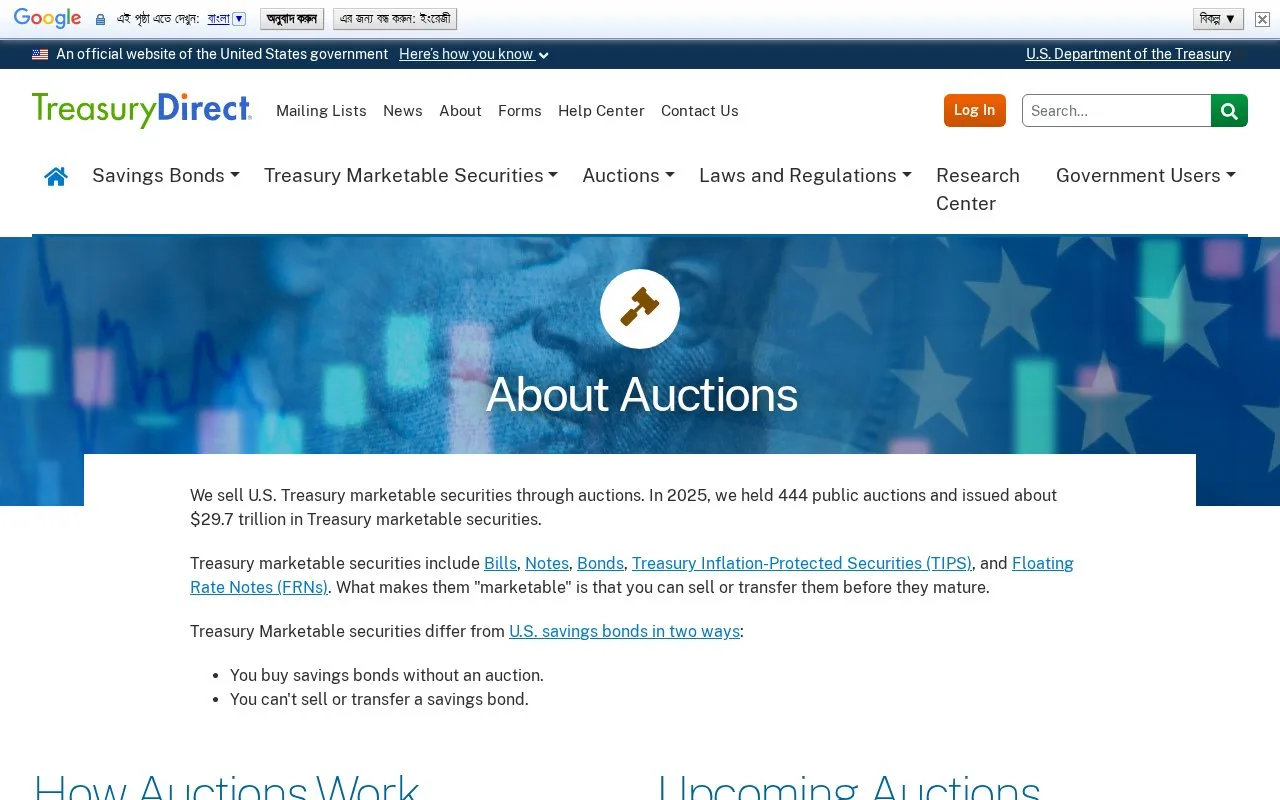
TreasuryDirect's public auction pages bring together upcoming U.S. Treasury announcements, recent results and a historical search. Researchers can follow a security by its CUSIP identifier, compare auction dates and download the selected data. Reading these records does not require a TreasuryDirect investing account.
Use an announcement to identify the security and auction schedule, then the result to see the completed auction. The main Auctions page separates upcoming announcements, recent results and historical searches, so you can move from the next issue to an older auction without entering a bid.
In Auction Query, filter Security Type and enter a CUSIP, the identifier for a particular security, when you want to follow that issue. Use the calendar control for dates: double-click one day, or click the first and last day of a range. A column's menu sorts its values; Show / Hide Columns adds fields that are absent from the default view. Remove Filter clears a text filter.
Download the selection as CSV or TSV for a spreadsheet, or JSON or XML for software. The CUSIP link also leads to interest-payment dates and related STRIPS identifiers, useful when looking at securities whose interest and principal can trade separately.
This is free public research, with no account needed for the search and download pages. Historical coverage starts in 1997 for Treasury Inflation-Protected Securities (TIPS) and on July 27, 1998 for other security types. Fields added later will not provide the same history as the oldest auction records. Keep the security type with any rate or yield you quote: a bill, a fixed-rate note and a floating-rate note are different instruments.
Strengths
- Offers issue-specific CUSIP and calendar-range searches
- Exports selected auction data in four common file formats
- Connects upcoming announcements, completed results and historical records
Watch out for
- Historical coverage starts in 1997 or 1998, depending on security type
- Some data fields were introduced after the earliest auction records
Best for
- Researchers comparing U.S. Treasury auction results
- Investors tracing a Treasury security's issuance and payment dates
Sources
- Treasury auctions: announcements and results (Oct 27, 2026)
- Auction Search: historical coverage and downloads (Oct 27, 2026)
- How to use the Auction Query database (Oct 27, 2026)