
What it does
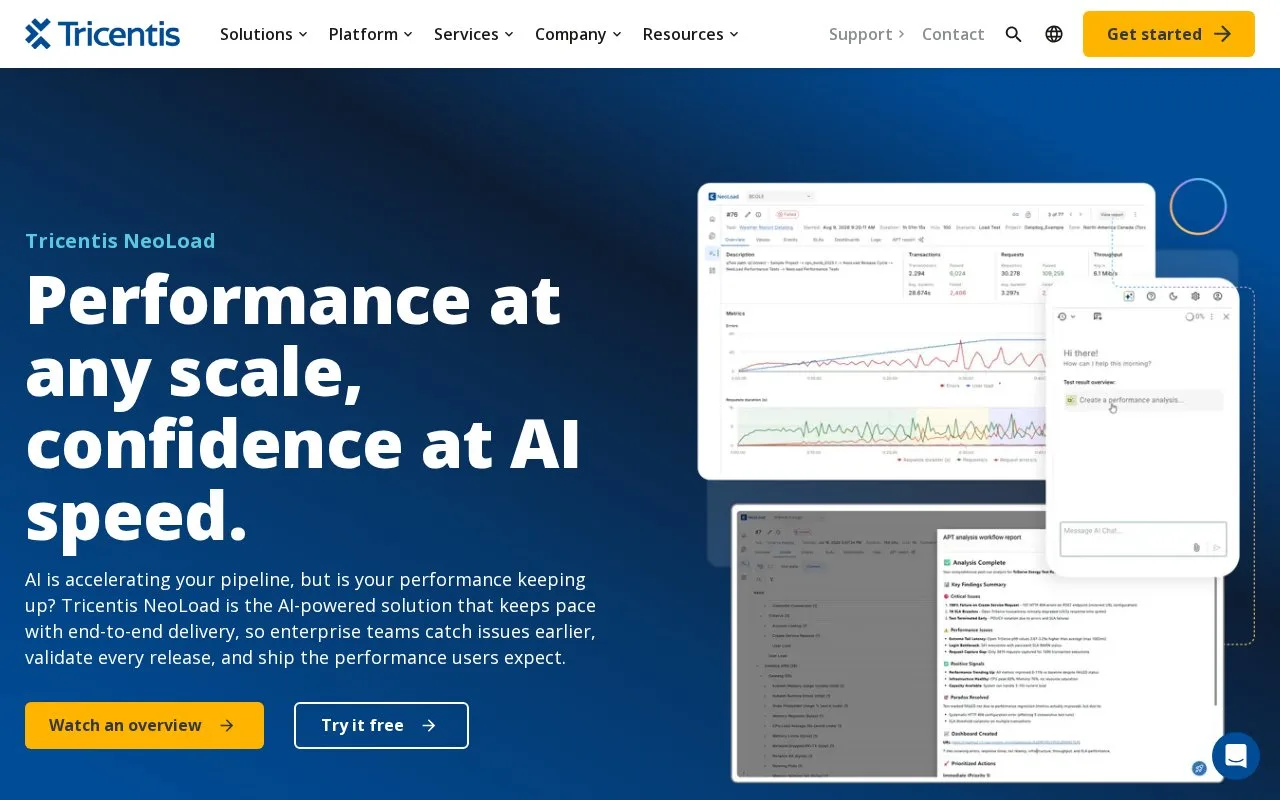
Tricentis NeoLoad is a performance and load-testing platform for web applications, APIs and enterprise systems. Its documented workflow can record user interactions through an HTTP proxy or browser, import API collections, define virtual-user and scenario behavior, and run tests with real-time graphs and statistical tables. It also provides reports and REST APIs for automating test operations and connecting results to CI/CD workflows.
Start with a small load model
The NeoLoad quick-start guide recommends opening the sample project included with the installation before designing a test of your own. A tester can record user actions through the standard HTTP proxy or RealBrowser, or import an API collection; then set virtual-user counts, scenario settings and user behavior parameters. During a run, the guide describes monitoring graphs and statistical tables, then reviewing results against business criteria and generating a report to share.
This is performance testing, so the team supplies a reachable application or API, the traffic pattern it wants to represent, and an environment where the generated load is appropriate. NeoLoad documentation calls out installation, license activation, architecture choices and precautions for high-volume tests. Keep load checks in a controlled environment unless the production owner has explicitly authorized that test.
The product's pricing page asks prospective customers to request NeoLoad pricing, while the documentation links to a separate free-trial download. The pricing page does not state a rate or a plan unit, so this entry classifies the commercial product as contact-for-pricing and leaves exact cost open. A documented REST API can automate test design, execution and result retrieval when the team is ready to connect it to CI.
Strengths
- The workflow supports both recorded user journeys and imported API collections.
- Load scenarios expose virtual-user and behavior settings and provide live graphs and statistical tables during execution.
- The REST API documents operations for test management, execution control, results and resources.
Watch out for
- A usable test requires a licensed NeoLoad environment, an application or API target and a carefully selected load profile.
Best for
- Performance engineers measuring how web applications and APIs respond under planned load.
- Teams that need to connect load-test runs and results to CI/CD pipelines.
- Organizations validating enterprise application performance across recorded front-end and API traffic.
Sources
- AI-driven automated performance & load testing tool - Tricentis NeoLoad (Oct 25, 2026)
- Request Tricentis NeoLoad pricing (Oct 25, 2026)
- Get started (Oct 25, 2026)
- REST API (Oct 25, 2026)