
What it does
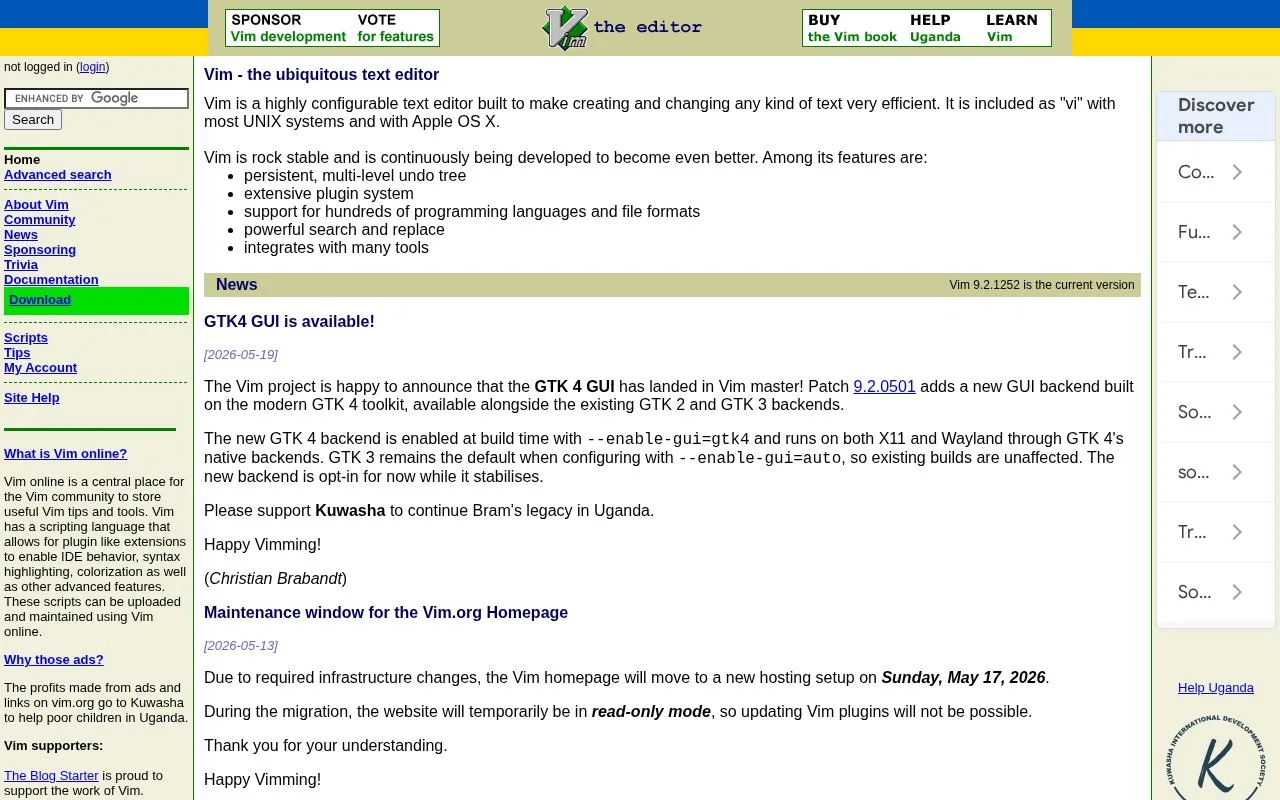
Vim is a highly configurable text editor descended from vi, with a command-driven editing model, syntax support for programming languages and file formats, search and replace, scripting, and an extension ecosystem. It is a local editor rather than a hosted development environment. Its small, keyboard-centered editing model can be adapted to source code, configuration files, and other plain text, but new users need to learn its modes and commands.
A compact editing loop
Vim's manual begins with a deliberately small first task: open a file, insert text, move around, make changes, undo them, and find help. The same manual explains that Vim separates text entry from command-driven navigation and editing, so a reader can learn the editing model in stages instead of trying to memorize every command first. For a concrete starting point, the official guide shows launching gvim file.txt; it also recommends practicing the basic commands before moving into more advanced material.
Once that interaction is familiar, Vim's scripting and configurable settings let a developer tailor the editor, while the official site points to syntax support, search-and-replace, and community-maintained scripts. This makes it useful for quick code edits as well as longer programming sessions, but the setup is not an out-of-the-box graphical IDE with project management and a beginner-focused interface. The project describes Vim as charityware: the editor may be used and copied, and donations are encouraged rather than presented as a purchase requirement. Its license is the Vim License, described in the manual as GPL-compatible; it is not simply labeled GPL in the opened license text.
Strengths
- The official project documents support for hundreds of programming languages and file formats, plus extensive search and replace.
- The scripting language and extension ecosystem allow users to adapt the editor for language-specific or IDE-like tasks.
- The official manual provides a staged tutorial and built-in help references for learning the modal editing model.
Watch out for
- The Vim site explicitly describes it as a tool users must learn rather than an editor designed to guide them through editing.
- Vim is a text editor, not a WYSIWYG word processor or a complete graphical IDE.
Best for
- Developers who want keyboard-driven editing for source files and configuration text
- Users who need a configurable editor available across common desktop and Unix-like systems
Sources
- welcome home : vim online (Oct 25, 2026)
- about Vim : vim online (Oct 25, 2026)
- download : vim online (Oct 25, 2026)
- Vim: usr_02.txt (Oct 25, 2026)
- Vim: usr_03.txt (Oct 25, 2026)
- Vim: uganda.txt (Oct 25, 2026)