
What it does
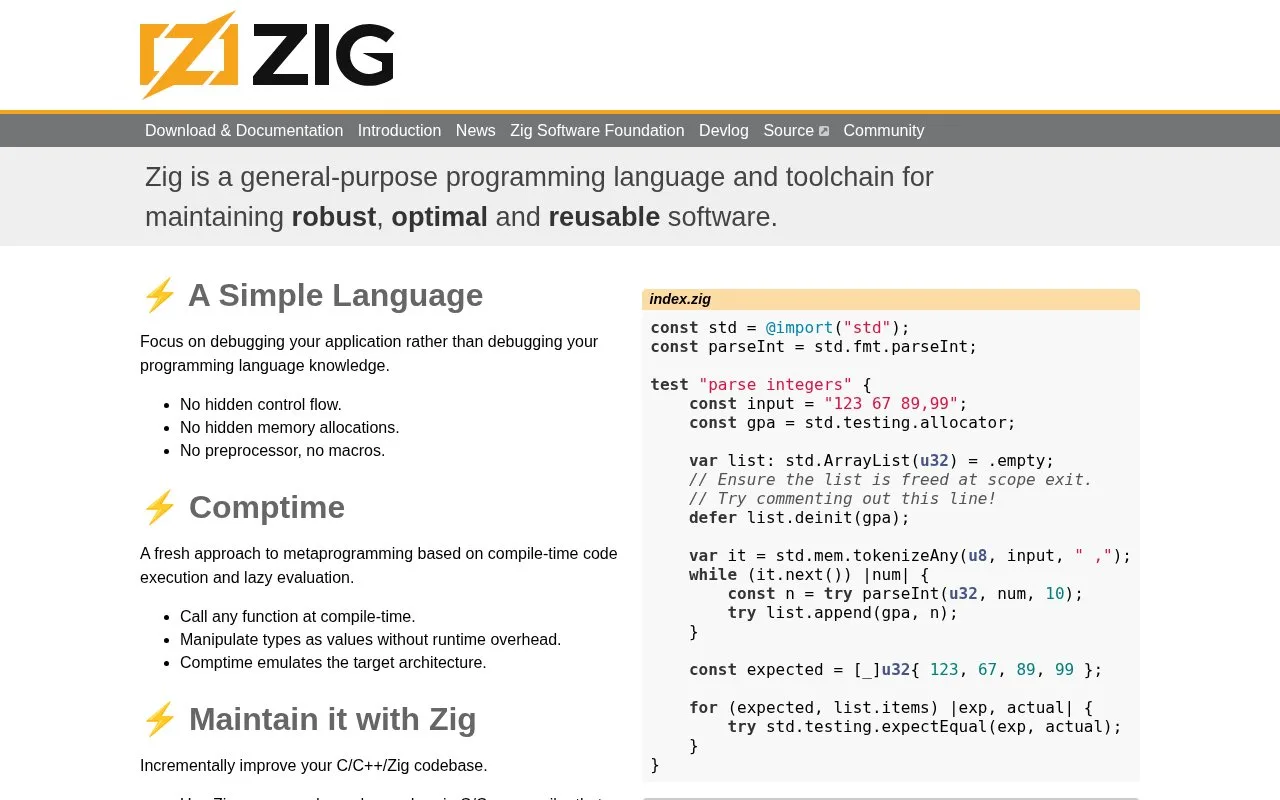
Zig is a programming language and compiler toolchain for building applications and systems software. Its design emphasizes explicit memory allocation and control flow, with compile-time execution for metaprogramming. The project also documents using Zig to compile C and C++ and to cross-compile, making it relevant to new systems projects and existing C or C++ codebases. Official downloads and versioned language and standard-library documentation are available for Windows, macOS, and Linux.
Start with a matching release
The official download page lists stable releases and separate archives for Windows, macOS, and Linux. Zig's installation guide describes its release archives as self-contained: unpack the compiler and its lib/ directory, then add the compiler to PATH if you want to invoke it from any directory. Use the language reference and standard-library documentation for the same Zig version rather than assuming the moving master documentation matches a stable release.
For a first check, put a test declaration in a source file and run zig test index.zig. The official project site uses that command in its sample. For project-specific build steps, the project describes zig build; its overview also explains how Zig can be used with C and C++ and for cross-compilation. The project warns that its official learning materials are not yet extensive, so a new user may need other learning resources alongside the reference. At the time checked, the download page labelled 0.17.0 as the latest stable version. The current Codeberg history listed Merge pull request 'Elf2: performance improvements & small refactors' (#37400) first, followed by spirv: fix negative integers in switch.
Strengths
- The language overview emphasizes explicit control flow and memory allocation rather than hidden behavior.
- Zig is documented as a way to compile C and C++ and cross-compile without a separate compiler wrapper.
- The official download page offers release archives for Windows, macOS, and Linux.
Watch out for
- The project says its official learning materials are not yet extensive, which may leave beginners relying on additional resources.
Best for
- Systems programming where explicit memory management and compile-time execution are useful
- Cross-compiling or incrementally improving a C or C++ codebase
Sources
- Zig Programming Language (Oct 25, 2026)
- Getting Started, Zig Programming Language (Oct 25, 2026)
- ziglang/zig, General-purpose programming language and toolchain (Oct 25, 2026)
- ziglang/zig commit history (Oct 25, 2026)
- zig/LICENSE at master (Oct 25, 2026)
- Download and Documentation, Zig Programming Language (Oct 25, 2026)